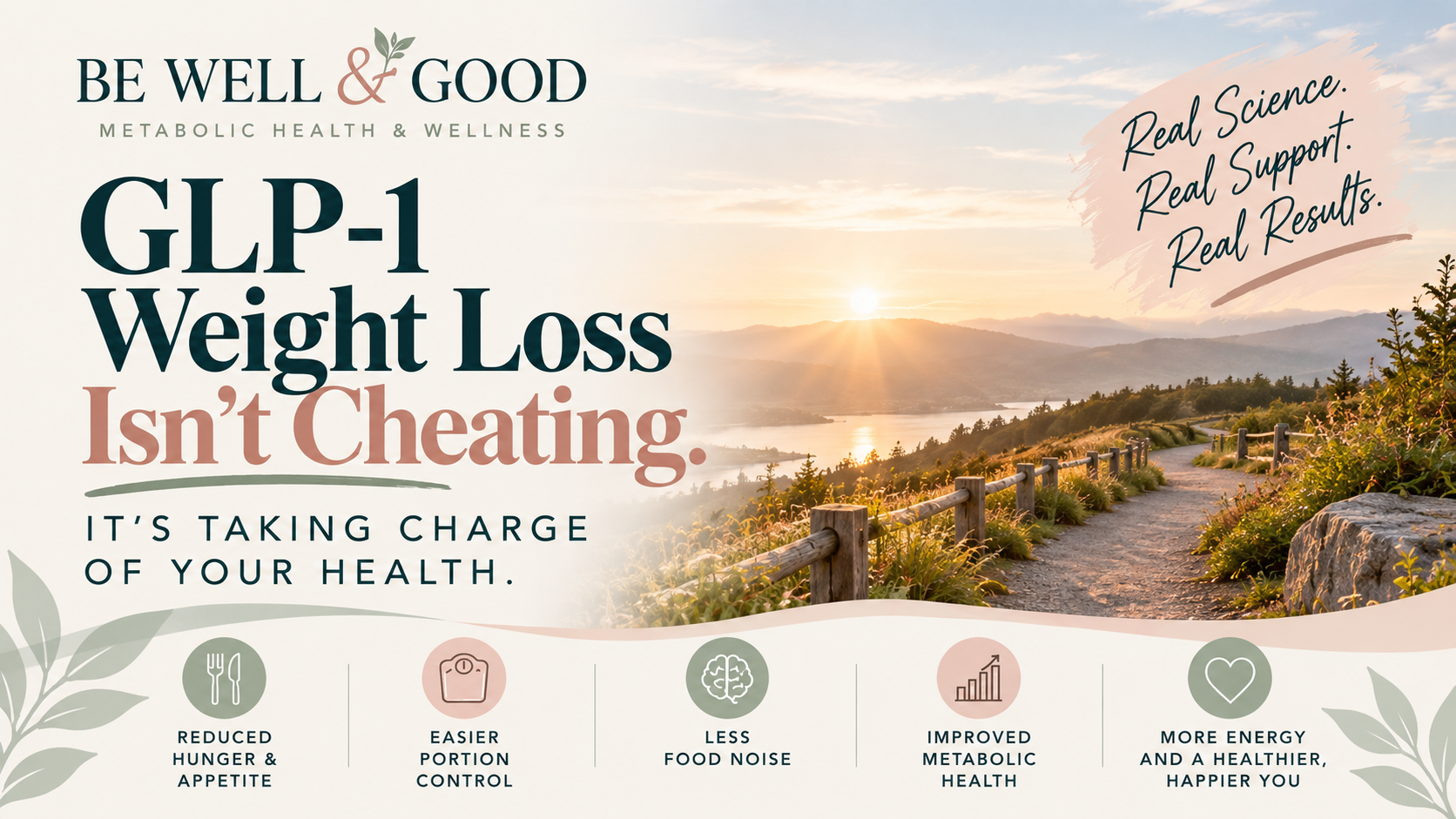
Taking a GLP-1 Isn't Cheating: Why Getting Help With Weight Loss Is a Smart Health Decision
Taking a GLP-1 Isn't Cheating: Why Getting Help With Weight Loss Is a Smart Health Decision
By Dr. Kris Garverick, CRNP | Be Well & Good
For years, we've been told that losing weight is simple: eat less, move more, and have more willpower.
But if you've struggled with your weight, you probably know it's not always that easy.
Maybe you've tried countless diets. You've tracked calories, increased your exercise, cut out your favorite foods, and started over more times than you can count.
And yet, the weight either doesn't come off or eventually comes back.
Now, with medications like Wegovy and Zepbound becoming more widely discussed, there's a new conversation happening around weight loss.
Is taking a GLP-1 medication cheating?
My answer is simple: Absolutely not.
Choosing medical treatment to improve your health isn't cheating. It's recognizing that weight management involves more than willpower and that sometimes your body needs additional support.
Weight Loss Is More Than Just Willpower
One of the biggest misconceptions about weight loss is that people who struggle simply aren't trying hard enough.
The truth is that body weight is influenced by many factors, including:
Genetics and family history
Hormones that regulate hunger and fullness
Metabolism and energy expenditure
Sleep and stress
Age-related changes in body composition
Certain medications and medical conditions
Your body has complex systems that regulate appetite, energy balance, and weight.
When you lose weight, your body may respond by increasing hunger and making it harder to maintain that weight loss.
This is one reason why losing weight—and keeping it off—can be so challenging.
Struggling with weight doesn't mean you lack discipline. It means weight management is more complicated than we've been led to believe.
How Do GLP-1 Medications Help?
GLP-1 medications work with the body's natural systems involved in appetite and blood sugar regulation.
Depending on the medication, they can help:
Reduce hunger and appetite
Increase feelings of fullness
Decrease the constant urge to think about food, sometimes called food noise
Support better blood sugar regulation
Make it easier to maintain a reduced-calorie eating pattern
Some medications, such as tirzepatide (Zepbound), work on both GLP-1 and GIP receptors.
Think of it this way:
If you've spent years feeling hungry shortly after eating, constantly thinking about your next meal, or struggling to feel satisfied, medication may help make those signals more manageable.
For some people, this creates the opportunity to build healthier habits without feeling like they're fighting their appetite every minute of the day.
That's not cheating. That's using medical science to address a real biological challenge.
We Don't Call Other Medical Treatments Cheating
Think about how we approach other health conditions.
If someone has high blood pressure, we don't tell them that taking medication is cheating because they should be able to lower it through lifestyle changes alone.
If someone has diabetes, we don't shame them for needing medication to help manage their blood sugar.
We recognize that medications can be valuable tools alongside healthy lifestyle habits.
Weight management deserves the same understanding.
Obesity is recognized as a chronic, complex disease, and for appropriate patients, prescription weight management medication can be part of evidence-based treatment.
There is no extra prize for improving your health the hardest way possible.
GLP-1 Medications Don't Replace Healthy Habits
Here's something I emphasize with patients at Be Well & Good:
The medication is a tool—not the entire plan.
Successful medical weight management still involves taking care of your body.
That means focusing on:
Protein: Eating enough protein to help preserve muscle while losing weight.
Nutrition: Choosing balanced meals that provide the nutrients your body needs.
Strength training: Building and maintaining muscle to support long-term health and function.
Hydration: Drinking enough fluids, particularly when appetite and food intake decrease.
Consistency: Developing realistic habits you can maintain beyond the initial weight loss phase.
GLP-1 medications may make these changes easier for some patients, but they don't eliminate the need for them.
They also aren't appropriate for everyone. Potential side effects, medical history, contraindications, medication interactions, cost, and long-term treatment plans all need to be considered.
What About People Who Say You're Taking the Easy Way Out?
Unfortunately, there's still a lot of judgment surrounding weight loss medications.
You may hear comments like:
"Why don't you just eat less?"
"You should be able to do it naturally."
"You're taking the easy way out."
But here's what I want you to remember:
You don't owe anyone an explanation for how you choose to take care of your health.
There is nothing wrong with seeking medical guidance, considering treatment options, or using a medication that may help you improve your health.
And taking a GLP-1 isn't always easy.
Patients may need to manage side effects, make meaningful changes to their eating habits, prioritize protein, incorporate strength training, and commit to ongoing follow-up.
It's still a commitment to your health.
The Goal Isn't Just a Smaller Number on the Scale
At Be Well & Good, I want patients to think beyond the number on the scale.
The bigger goal is improving overall health and quality of life.
Depending on the individual, successful weight management may help improve metabolic health, mobility, physical function, and certain weight-related health conditions.
And sometimes the biggest change isn't physical.
It's feeling more confident about making healthy choices, having a plan that feels manageable, and no longer feeling defeated by repeated attempts at weight loss.
Not everyone will have the same results, and GLP-1 medications are not a guarantee. But for appropriate patients, they can be an effective part of a comprehensive treatment plan.
It's Time to Change the Conversation
Instead of asking whether using a GLP-1 is cheating, maybe we should be asking a different question:
What tools and support will help me improve my health in a safe, sustainable way?
For some people, that may be nutrition and lifestyle changes alone.
For others, medical weight management may include prescription medication.
Neither approach makes someone more deserving of success.
What matters is finding a treatment plan that is appropriate for your health, your needs, and your long-term goals.
Ready to Put Your Health First?
At Be Well & Good, I believe weight management should be personalized, supportive, and free from judgment.
We offer medical weight management services for men and women, including:
Individualized weight management consultations
GLP-1 medication evaluation and management when appropriate
Personalized nutrition guidance
Support with medication side effects
Ongoing monitoring and lifestyle guidance
Whether you're just beginning to explore GLP-1 medications or you've been struggling with weight loss for years, you deserve a plan that takes your individual needs into account.
You aren't cheating by asking for help. You're making your health a priority.
And that's something to feel good about.
Dr. Kris Garverick, CRNP
Be Well & Good
Medical Weight Management & Nutrition
www.bewellngood.com
Disclaimer: This article is for educational purposes and is not a substitute for individualized medical advice. GLP-1 medications require a medical evaluation and may not be appropriate for everyone.
By Dr. Kris Garverick, CRNP | Be Well & Good
For years, we've been told that losing weight is simple: eat less, move more, and have more willpower.
But if you've struggled with your weight, you probably know it's not always that easy.
Maybe you've tried countless diets. You've tracked calories, increased your exercise, cut out your favorite foods, and started over more times than you can count.
And yet, the weight either doesn't come off or eventually comes back.
Now, with medications like Wegovy and Zepbound becoming more widely discussed, there's a new conversation happening around weight loss.
Is taking a GLP-1 medication cheating?
My answer is simple: Absolutely not.
Choosing medical treatment to improve your health isn't cheating. It's recognizing that weight management involves more than willpower and that sometimes your body needs additional support.
Fill out this questionaire to learn more & I will reach out personally
Weight Loss Is More Than Just Willpower
One of the biggest misconceptions about weight loss is that people who struggle simply aren't trying hard enough.
The truth is that body weight is influenced by many factors, including:
Genetics and family history
Hormones that regulate hunger and fullness
Metabolism and energy expenditure
Sleep and stress
Age-related changes in body composition
Certain medications and medical conditions
Your body has complex systems that regulate appetite, energy balance, and weight.
When you lose weight, your body may respond by increasing hunger and making it harder to maintain that weight loss.
This is one reason why losing weight—and keeping it off—can be so challenging.
Struggling with weight doesn't mean you lack discipline. It means weight management is more complicated than we've been led to believe.
How Do GLP-1 Medications Help?
GLP-1 medications work with the body's natural systems involved in appetite and blood sugar regulation.
Depending on the medication, they can help:
Reduce hunger and appetite
Increase feelings of fullness
Decrease the constant urge to think about food, sometimes called food noise
Support better blood sugar regulation
Make it easier to maintain a reduced-calorie eating pattern
Some medications, such as tirzepatide (Zepbound), work on both GLP-1 and GIP receptors.
Think of it this way:
If you've spent years feeling hungry shortly after eating, constantly thinking about your next meal, or struggling to feel satisfied, medication may help make those signals more manageable.
For some people, this creates the opportunity to build healthier habits without feeling like they're fighting their appetite every minute of the day.
That's not cheating. That's using medical science to address a real biological challenge.
We Don't Call Other Medical Treatments Cheating
Think about how we approach other health conditions.
If someone has high blood pressure, we don't tell them that taking medication is cheating because they should be able to lower it through lifestyle changes alone.
If someone has diabetes, we don't shame them for needing medication to help manage their blood sugar.
We recognize that medications can be valuable tools alongside healthy lifestyle habits.
Weight management deserves the same understanding.
Obesity is recognized as a chronic, complex disease, and for appropriate patients, prescription weight management medication can be part of evidence-based treatment.
There is no extra prize for improving your health the hardest way possible.
GLP-1 Medications Don't Replace Healthy Habits
Here's something I emphasize with patients at Be Well & Good:
The medication is a tool—not the entire plan.
Successful medical weight management still involves taking care of your body.
That means focusing on:
Protein: Eating enough protein to help preserve muscle while losing weight.
Nutrition: Choosing balanced meals that provide the nutrients your body needs.
Strength training: Building and maintaining muscle to support long-term health and function.
Hydration: Drinking enough fluids, particularly when appetite and food intake decrease.
Consistency: Developing realistic habits you can maintain beyond the initial weight loss phase.
GLP-1 medications may make these changes easier for some patients, but they don't eliminate the need for them.
They also aren't appropriate for everyone. Potential side effects, medical history, contraindications, medication interactions, cost, and long-term treatment plans all need to be considered.
What About People Who Say You're Taking the Easy Way Out?
Unfortunately, there's still a lot of judgment surrounding weight loss medications.
You may hear comments like:
"Why don't you just eat less?"
"You should be able to do it naturally."
"You're taking the easy way out."
But here's what I want you to remember:
You don't owe anyone an explanation for how you choose to take care of your health.
There is nothing wrong with seeking medical guidance, considering treatment options, or using a medication that may help you improve your health.
And taking a GLP-1 isn't always easy.
Patients may need to manage side effects, make meaningful changes to their eating habits, prioritize protein, incorporate strength training, and commit to ongoing follow-up.
It's still a commitment to your health.
The Goal Isn't Just a Smaller Number on the Scale
At Be Well & Good, I want patients to think beyond the number on the scale.
The bigger goal is improving overall health and quality of life.
Depending on the individual, successful weight management may help improve metabolic health, mobility, physical function, and certain weight-related health conditions.
And sometimes the biggest change isn't physical.
It's feeling more confident about making healthy choices, having a plan that feels manageable, and no longer feeling defeated by repeated attempts at weight loss.
Not everyone will have the same results, and GLP-1 medications are not a guarantee. But for appropriate patients, they can be an effective part of a comprehensive treatment plan.
It's Time to Change the Conversation
Instead of asking whether using a GLP-1 is cheating, maybe we should be asking a different question:
What tools and support will help me improve my health in a safe, sustainable way?
For some people, that may be nutrition and lifestyle changes alone.
For others, medical weight management may include prescription medication.
Neither approach makes someone more deserving of success.
What matters is finding a treatment plan that is appropriate for your health, your needs, and your long-term goals.
Ready to Put Your Health First?
At Be Well & Good, I believe weight management should be personalized, supportive, and free from judgment.
We offer medical weight management services for men and women, including:
Individualized weight management consultations
GLP-1 medication evaluation and management when appropriate
Personalized nutrition guidance
Support with medication side effects
Ongoing monitoring and lifestyle guidance
Whether you're just beginning to explore GLP-1 medications or you've been struggling with weight loss for years, you deserve a plan that takes your individual needs into account.
You aren't cheating by asking for help. You're making your health a priority.
Ready to learn more: Click here to fill out my intake questionniare to learn more.
And that's something to feel good about.
Dr. Kris Garverick, CRNP
Be Well & Good
Medical Weight Management & Nutrition
Disclaimer: This article is for educational purposes and is not a substitute for individualized medical advice. GLP-1 medications require a medical evaluation and may not be appropriate for everyone.